
Note · Woods
Baobab
Adansonia digitata
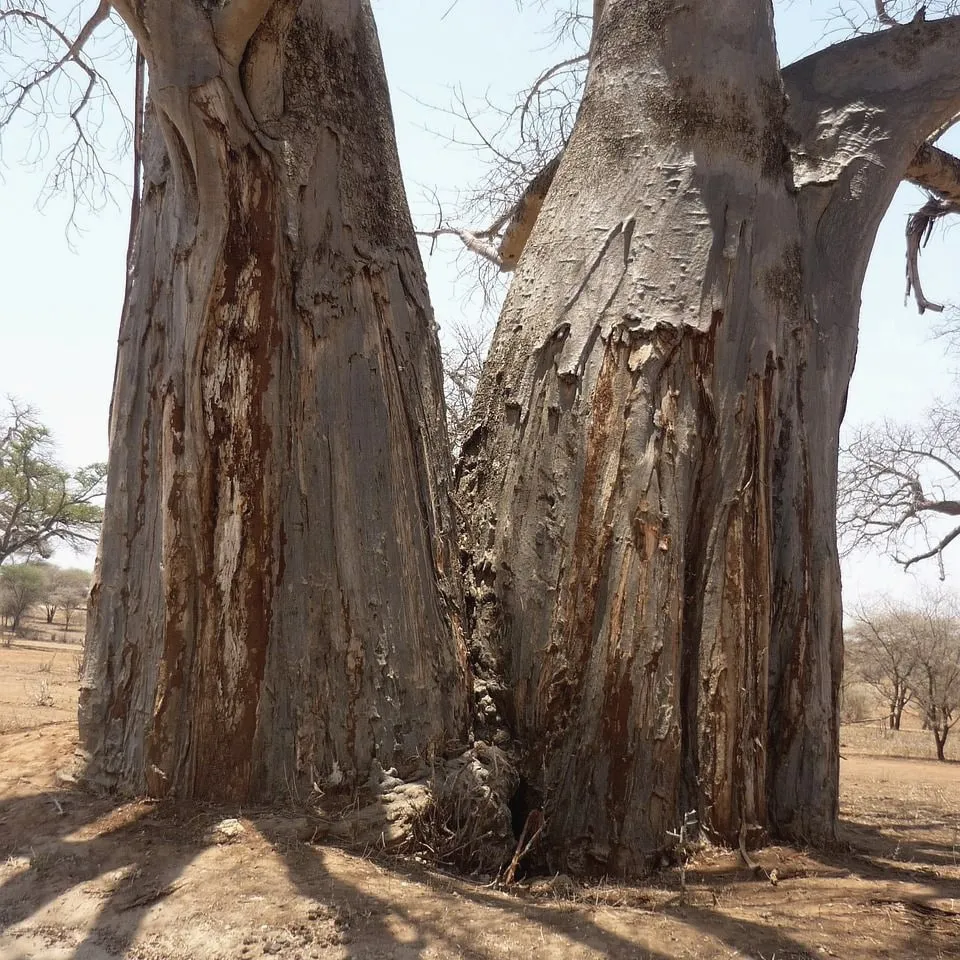
Photo: ajoheyho (new tab) / Pixabay (new tab)
The baobab yields no wood oil: its note is an evocation, dry and powerful, of its massive bark and the savannah around it.
What it brings
A dry, ample woody presence.
Origins and uses
The African baobab, Adansonia digitata, is the emblematic tree of the dry savannas of tropical Africa, from the Sahel to South Africa. It can reach 25 metres in height, with a trunk 5 to 7 metres across whose soft, water-filled wood acts as a reserve during the dry season. Some specimens are said to be over 2,000 years old. Its fruit, "monkey bread", gives a pulp rich in vitamin C, and the tree, often sacred, is nicknamed the "tree of life".
The baobab provides no wood essence for perfumery: its note is an evocation imagined by the perfumer. It seeks to convey the dry power of its massive bark and the hot air of the savanna, and pairs with woods and spices.
In our catalogue, baobab is at the centre of Cri du Kalahari by Ella K Parfums, surrounded by green pepper, orris, cedarwood, sandalwood and patchouli.
Text written with the help of AI, based on reference sources: encyclopedias, raw-material manufacturers and official information from the fragrance houses.
Material profile
- Family
- Woods
- Nature
- Perfumer’s accord
- Botanical name
- Adansonia digitata
- Origin
- An accord imagined by the perfumer, in tribute to the African tree.
- How it is obtained
- Recomposed by the perfumer
- On Volute
- 1 fragrance
The fragrances that reveal it
In the same family · Woods
- Akigalawood
- Ambery cedar notes
- Amyris
- Black hemlock
- Blond woods
- Cade oil
- Cashmeran
- Cashmere wood
- Cedarwood
- Clearwood
- Coconut wood
- Cypress
- Cypriol
- Driftwood
- Ebony wood
- Fig wood
- Fir
- Georgywood
- Guaiac wood
- Kingwood
- Lorenox
- Mahogany
- Musky woody notes
- Oak
- Orcanox
- Oud
- Palo santo
- Papyrus
- Patchouli
- Pine
- Pine needles
- Rosewood
- Sandalwood
- Smoked wood accord
- Teak
- Thuja
- Vetiver
- Woody notes