
Note · Flowers
Lily
Lilium candidum
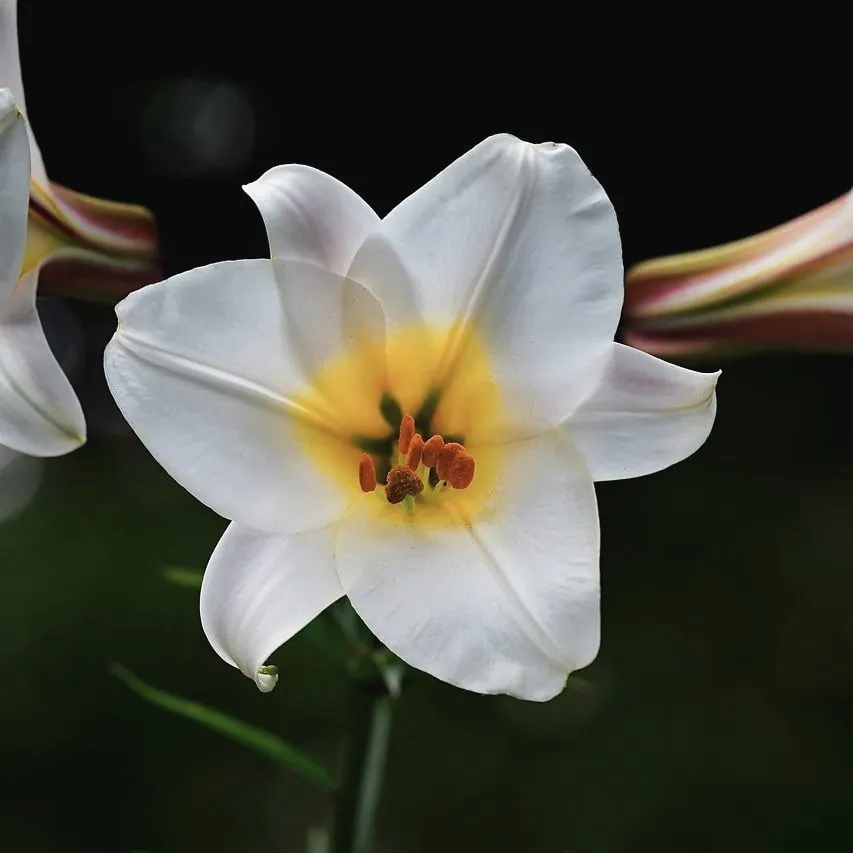
Photo: Couleur (new tab) / Pixabay (new tab)
Lily does not lend itself to extraction: the perfumer recreates its powdery, spicy floral character, with a honeyed facet and a green freshness.
What it brings
An ample, luminous floral note, lightly spiced.
Origins and uses
The lily is one of the flowers cultivated for the longest time. The Madonna lily, Lilium candidum, comes from the eastern Mediterranean, from the Balkans and Greece to Lebanon and Syria, and has spread to many regions. In the Middle Ages, Charlemagne's capitulary De Villis listed it among the plants to be grown, and it was credited with powers linked to love.
The lily lends itself poorly to extraction: in perfumery, its note is recreated. The perfumer rebuilds its powdery, slightly spicy floral character, with a honeyed facet and a green freshness. It sits in the heart of white-flower bouquets, to which it gives breadth.
In our catalogue, lily is part of the heart of Night Scented Jasmine by Floris, a large bouquet where it mingles with jasmine, gardenia, mimosa and narcissus.
Text written with the help of AI, based on reference sources: encyclopedias, raw-material manufacturers and official information from the fragrance houses.
Material profile
- Family
- Flowers
- Nature
- Perfumer’s accord
- Botanical name
- Lilium candidum
- Origin
- A note recomposed by the perfumer.
- How it is obtained
- Recomposed by the perfumer
- On Volute
- 8 fragrances
The fragrances that reveal it
In the same family · Flowers
- Blue poppy
- Broom
- Camellia
- Carnation
- Centifolia rose
- Cherry blossom
- Crocus flower
- Cyclamen
- Damask rose
- Freesia
- Geranium
- Ginger flower
- Hawthorn
- Heliotrope
- Heliotropin
- Hibiscus
- Honeysuckle
- Hyacinth
- Jonquil
- Lilac
- Lily of the valley
- Linden blossom
- Lotus flower
- Magnolia
- Mahonial
- Mimosa
- Narcissus
- Orchid
- Orris
- Osmanthus
- Peach blossom
- Peony
- Petalia
- Raspberry blossom
- Rose
- Rose oxide
- Salicylate notes
- Sweet pea
- Tagetes
- Tobacco flower
- Tulip
- Violet
- Water lily