
Note · Flowers
Linden blossom
Tilia
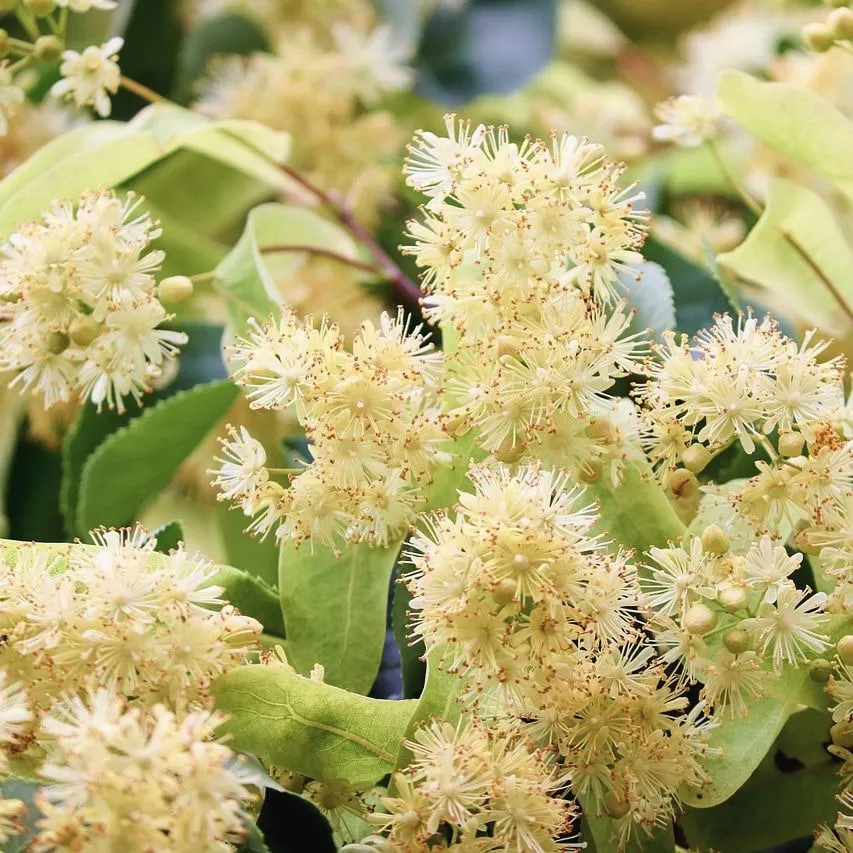
Linden blossom smells of honey, fresh hay and evening tisane. Its absolute being rare, the note is most often recomposed.
What it brings
A soothing, honeyed green sweetness.
Origins and uses
Linden trees, of the genus Tilia, are large trees of Europe, Asia and North America, with heart-shaped leaves. In June and July, they are covered with small fragrant flowers, grouped beneath a yellowish bract, which attract bees and give a pale honey. Dried, these flowers make a very popular infusion, appreciated for its taste and soothing effect. A symbol of love and fidelity, the linden was also the tree of village gatherings, and many were planted in France as trees of liberty during the Revolution.
Linden flowers are used in perfumery; their scent owes much to farnesol, identified in 1923 by the chemist Leopold Ružička. The note, most often recreated, is floral, honeyed and slightly green.
In our catalogue, linden blossom opens Frangipani by Ormonde Jayne, with magnolia and lime, and accompanies jasmine and orange blossom in La Chasse aux Papillons by L'Artisan Parfumeur.
Text written with the help of AI, based on reference sources: encyclopedias, raw-material manufacturers and official information from the fragrance houses.
Material profile
- Family
- Flowers
- Nature
- Perfumer’s accord
- Botanical name
- Tilia
- Origin
- A note recomposed by the perfumer.
- How it is obtained
- Recomposed by the perfumer
- On Volute
- 2 fragrances
The fragrances that reveal it
In the same family · Flowers
- Blue poppy
- Broom
- Camellia
- Carnation
- Centifolia rose
- Cherry blossom
- Crocus flower
- Cyclamen
- Damask rose
- Freesia
- Geranium
- Ginger flower
- Hawthorn
- Heliotrope
- Heliotropin
- Hibiscus
- Honeysuckle
- Hyacinth
- Jonquil
- Lilac
- Lily
- Lily of the valley
- Lotus flower
- Magnolia
- Mahonial
- Mimosa
- Narcissus
- Orchid
- Orris
- Osmanthus
- Peach blossom
- Peony
- Petalia
- Raspberry blossom
- Rose
- Rose oxide
- Salicylate notes
- Sweet pea
- Tagetes
- Tobacco flower
- Tulip
- Violet
- Water lily