
Note · Flowers
Freesia
Freesia
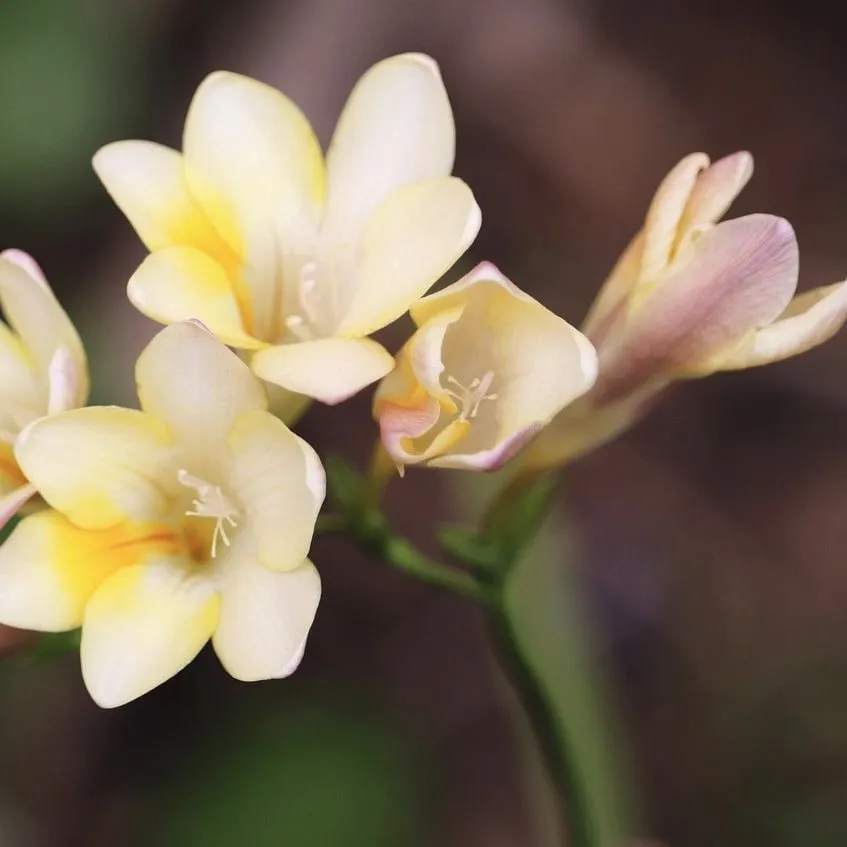
Photo: Buntysmum (new tab) / Pixabay (new tab)
Freesia cannot be extracted. Recomposed, it offers a fresh, peppery, lightly fruity and very luminous floral note.
What it brings
Freshness and transparency within a bouquet.
Origins and uses
Freesia is a bulbous plant of the iris family, native to South Africa, in the Cape Province. The botanist Ecklon named it in 1866 in honour of a German physician called Freese. Its highly fragrant flowers, often white, yellow or purple, have a scent often compared to that of jasmine. Hundreds of hybrids have been created, mainly for the cut-flower trade, and the plant thrives in a Mediterranean climate.
In perfumery, freesia cannot be extracted: its note is recreated by the perfumer. It brings a fresh, light, peppery, slightly fruity floral quality, often used in the heart of compositions to give them transparency.
In our catalogue, freesia opens Moon Carnival by Vilhelm Parfumerie, accompanies rose in the heart of Ta'if by Ormonde Jayne and appears in the base of 1872 Masculine by Clive Christian.
Text written with the help of AI, based on reference sources: encyclopedias, raw-material manufacturers and official information from the fragrance houses.
Material profile
- Family
- Flowers
- Nature
- Perfumer’s accord
- Botanical name
- Freesia
- Origin
- A flower recomposed by the perfumer.
- How it is obtained
- Recomposed by the perfumer
- On Volute
- 15 fragrances
The fragrances that reveal it
In the same family · Flowers
- Blue poppy
- Broom
- Camellia
- Carnation
- Centifolia rose
- Cherry blossom
- Crocus flower
- Cyclamen
- Damask rose
- Geranium
- Ginger flower
- Hawthorn
- Heliotrope
- Heliotropin
- Hibiscus
- Honeysuckle
- Hyacinth
- Jonquil
- Lilac
- Lily
- Lily of the valley
- Linden blossom
- Lotus flower
- Magnolia
- Mahonial
- Mimosa
- Narcissus
- Orchid
- Orris
- Osmanthus
- Peach blossom
- Peony
- Petalia
- Raspberry blossom
- Rose
- Rose oxide
- Salicylate notes
- Sweet pea
- Tagetes
- Tobacco flower
- Tulip
- Violet
- Water lily